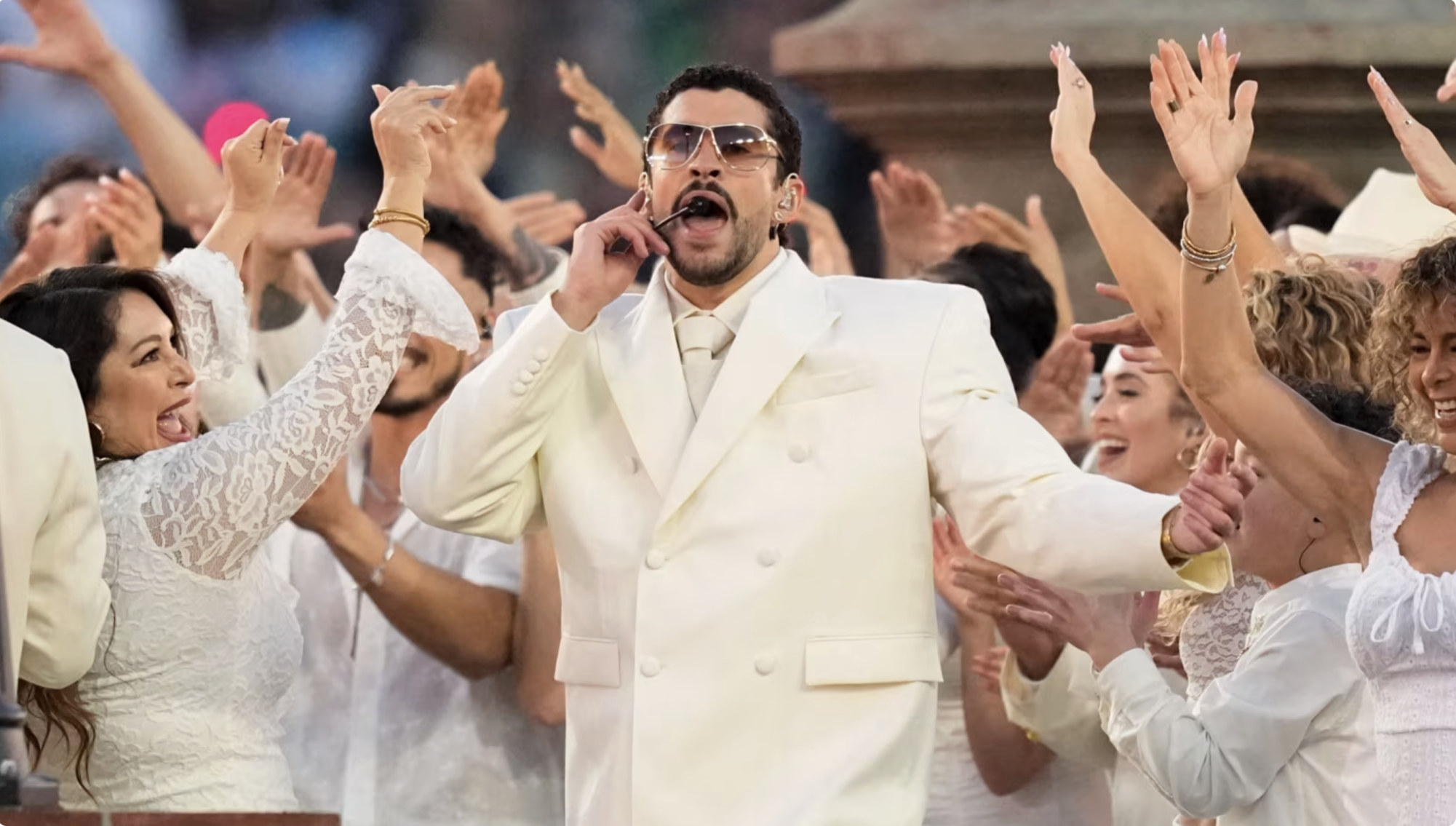
“THE ONLY THING MORE POWERFUL THAN HATE IS LOVE.”
This message was shown at the halftime show of Super Bowl LX, led by Puerto Rican artist Bad Bunny. This visual and emotional choice, along with many others, makes the show one to remember, as it encapsulates the vulnerability of the Latin community, especially during this time of ICE (Immigration and Customs Enforcement) deportations and the hate-fueled choices people are making.
During his performance, U.S. and Puerto Rican flags could be seen displayed behind him, and the digital screen illuminated by “the only thing more powerful than hate is love”, representing his wish for community between Latin America and North America. The show concludes with Bad Bunny shouting, “God Bless America,” and reciting the many countries and territories that comprise North America, including Puerto Rico, the United States, and Canada.
The United States is more divided now than ever before. Politically charged actions are creating this division, the most recent being the “alternative” Super Bowl performance featuring a “more American” artist. This split furthermore explains Bad Bunny’s motive behind the message: everyone should try to love one another to bridge the gap forming in our nation.
Additionally, there was discourse about the importance of having an American citizen as the halftime show, even though Puerto Rico is an American territory, and Bad Bunny is an American citizen. More importantly, it contributes to the United States economy, military, and trade.
For example, Puerto Rico is the main provider of pharmaceuticals and medical supplies, giving 19.3% of exports as of 2020. It is also a significant market for United States goods, providing over 4 billion dollars a year in federal taxes. As for their contributions to the United States military, Puerto Rican citizens have fought with the U.S. in every war it’s had since it became a U.S. territory on December 10th, 1898.
Bad Bunny highlights numerous Puerto Rican contributions to the United States in his show. He starts his performance in a sugarcane field, representing how the United States used Puerto Rico’s land and farmworkers to boost their economy through sugar plantations in 1898.
In this field, viewers see a low-income household and a broken electrical pole that sparked various times throughout the performance. These visuals allow Bad Bunny to show millions the harsh reality of poverty and struggles coming from a low-income household in Latin America, including electricity and infrastructure.
The inclusion of the electrical pole is also directly addressing Hurricane Maria in 2017, a natural event that resulted in the death of thousands and left parts of Puerto Rico without water and electricity. The president in office at the time, Donald Trump, responded to the anguish with an intentional delay of over 20 billion dollars meant for aid. Especially as a victim of the natural disaster, Bad Bunny used the halftime show to remind its viewers of the devastation, especially now that Trump is back in office.
He also sang a song titled “Lo Que Pasó a Hawaii” (What Happened to Hawaii), which addresses the fear of many Puerto Ricans about their territory being made a state of the U.S. and being gentrified like Hawaii was.
For example, the chorus states, “Quieren quitarme el río y también la playa… No, no suelte la bandera ni olvide el lelolai. Que no quiero que hagan contigo lo que le pasó a Hawái.” (They want to take away my river and my beach… No, don’t let go of the flag and don’t forget the lelolai. Because I don’t want them to do to you what happened to Hawaii.) This is a direct reference to how the U.S. tourist industry and colonization are ruining Hawaii and how Bad Bunny doesn’t want the same thing to happen to Puerto Rico.
To go along with this, he intentionally chooses to use a Puerto Rican flag with a lighter blue color, in contrast to the usual flags with medium or darker blue to match the United States flag. By choosing this lighter blue, Bad Bunny speaks about his desire for political independence for Puerto Rico and the absence of gentrification and colonization in the U.S. territory.
Along with these symbols, he also includes cultural food from Puerto Rico, such as shaved ice and coco frio, and an endangered animal, the concho frog, which is only found in Puerto Rico and the Virgin Islands. These aspects of Puerto Rican culture are ignored by the rest of the United States, which Bad Bunny brings to light.
To conclude, Bad Bunny’s performance in Super Bowl LX is powerful because it shows where his priorities lie. He’s made it clear that support for Puerto Rico is his main goal, and, despite President Trump’s negativity toward Bad Bunny and the Latin community, Bad Bunny continues to push the message that love is stronger than hate and that everyone should keep fighting for their beliefs.