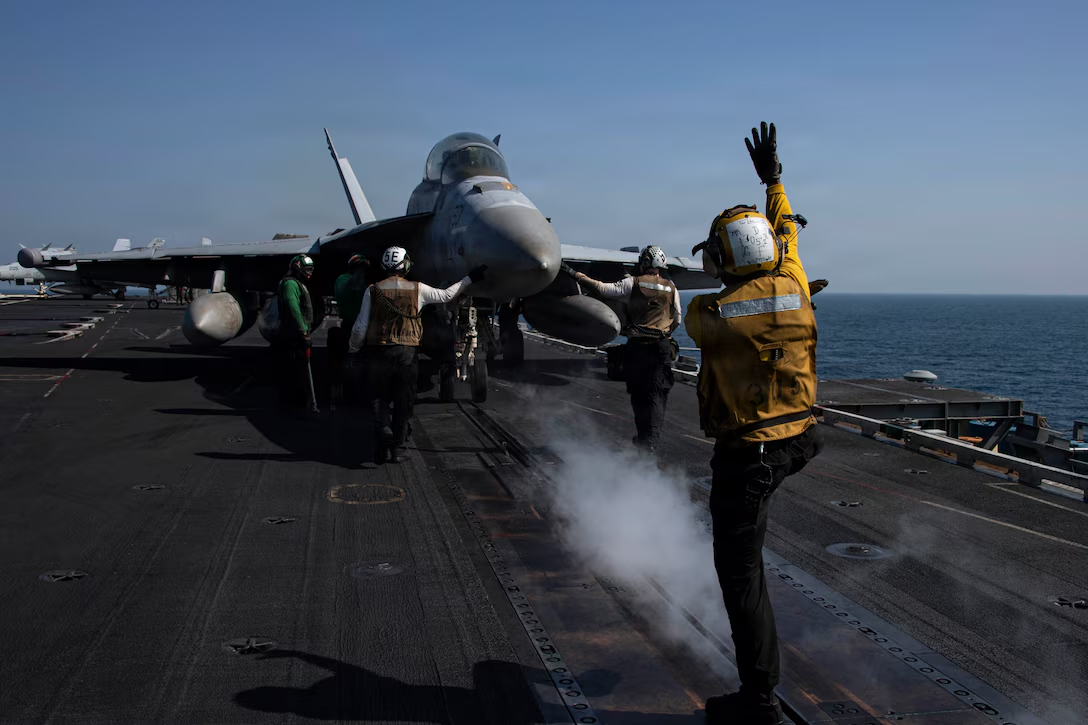
On February 28, 2026, the United States and Israel launched joint missile strikes, targeting several places across Iran. The supreme leader of Iran, Ali Khamenei was promptly pronounced dead, along with several other high ranking officials.
This conflict continues with President Trump’s continued action to prevent Iran from furthering their nuclear program which was also the grounds for the Twelve Day War that began on June 22 of 2025. During that period of heightened conflict, the United States Armed Forces bombed nuclear facilities throughout Iran.
Although the conflict may feel very far away for some, with Iran’s retaliatory strikes upwards of 12 countries are currently affected. Strikes have hit both military and civilian targets, but what does that mean for people back in the mainland U.S.?
Zach Galea, a junior and prominent student in Del Mar High School’s Junior Reserve Officers’ Training Corps, or JROTC program, has had an interest in joining the military since he was young, and finds it to be an excellent program whether students plan on enlisting or not.
“You can do ROTC and military service is not mandated. ROTC looks very good on college applications because the environment helps students build respect for people around them and [helps build] a high level of responsibility, knowing that your actions impact others,” says Galea.
When he first saw the news about the U.S. and Israeli strikes Galea was surprised, saying, “I was immediately searching for more information because it seemed unprecedented at the time. I still don’t necessarily agree with it. I think there are more peaceful ways to do it, rather than sending troops into battle.”
To Robert Heim—a history teacher at Del Mar High School—confirming the facts and doing research when learning about pertinent topics is extremely important; “It’s important to look at non U.S. news sources like the BBC or Al Jazeera and I think it’s also important to make sure that you are looking at the headline from multiple sources and perspectives.”
Part of Galea’s surprise comes with the fact that the attacks on Iran were illegal and seemingly unprecedented.
“If Iran had launched some form of operation against the United States, whether it be deploying troops, taking hostages, or even missile striking the U.S., that would call for some form of retaliation. But I think trying to immediately pursue a conflict without some form of action such as peace treaties is very uncalled for,” Galea says.
On why all people may not share Galea’s distaste for the current conflict he says, “I think it definitely depends on someone’s beliefs and or personal grudges, someone could have a very biased opinion based on the information that they are aware of.”
Heim, highlighting additional reasons for the division America faces on whether this war against Iran is warranted, and aligns with American ideals, says “I think the division in America stems from a few factors. There was no official declaration of war by Congress, and they are [supposed to be] the only ones who can declare war. [As well as the fact that] there is a very similar playbook to our wars in the early 2000s, and they did not go well.”
Regardless of current public opinion of the conflict between the U.S., Israel, and Iran, the American people have had a rocky relationship with both the military and the government leading it, characterized by periods of intense patriotism, and times of great protest.
A chemistry teacher at Del Mar, and former member of the United States Armed Services, Andrew Cerda, compares the public’s faith in its military to a pendulum.
“There’s periods where people love the US military, like World War Two, and periods where people hate it, like [the war in] Vietnam,” says Cerda, choosing to take an optimistic view of current events, “[…] I think right now we’re mid swing, not too heavy on either side.”
The support of citizens is a very important factor when it comes to waging armed conflicts on foreign states, and while many may express discontent with the military, Galea wants to remind others of how the chain of command works.
“Everyone in the military is on a government contract, and during times of war, if you refuse a direct order they could court martial you or throw you in prison,” says Galea. “I think theres a lot of trust within the military. I think the trust issue stems from the government, and the fact that the military is solely controlled by the president.”
The ability to separate the government and the military as two distinct organizations is a point that Cerda also stresses, “The US military is essentially seen as an extension of whatever political party is in power, so if people don’t like the person that’s in charge now all of a sudden they don’t like the military,which I don’t think is a fair assessment, [..] the people in the military are really good at their jobs, [and] so I think the problem doesn’t stem from the military itself,” he says.
An additional problem with this current conflict is the economic impacts it has. The Department of Defense reportedly told Congress that the first six days the war cost the U.S. $11.3 billion.
“The military is there to serve the people, as defense for the United States. I think that all the money that’s going to the military should strictly be used on building up the security of the nation and making sure people don’t get harmed.” said Galea, in response to the extreme military spending.
The prospect of an active conflict in the Middle East may seem daunting to some, but Galea isn’t “necessarily worried” despite the conflict’s high level of impact on the position he plans on enlisting for.
Yet for others, this conflict may present more pressing concerns. Cerda, an inactive service member has the chance of getting called back to service if tensions escalate to an extreme. He says, “I do [feel personally affected by the conflict] I’m still in the inactive reserve, so I could actually still be recalled into active duty, […] I don’t think it’s gonna happen, but it is a possibility.”
“I’m still not concerned, the United States has so many forward operating bases, we have Hawaii, Guam, we have bases in Japan and Korea… there’s a lot of military there, I would not be concerned about that.”
Whether you are still “unconcerned” about the war coming to the U.S. like Cerda, prefer to mostly stay out of foreign affairs like Galea, or want to stay updated like Heim, the conflict has a real impact on real people.
As the conflict progresses, fighting remains unpredictable, so its important to stay informed, stay aware, and stay safe.