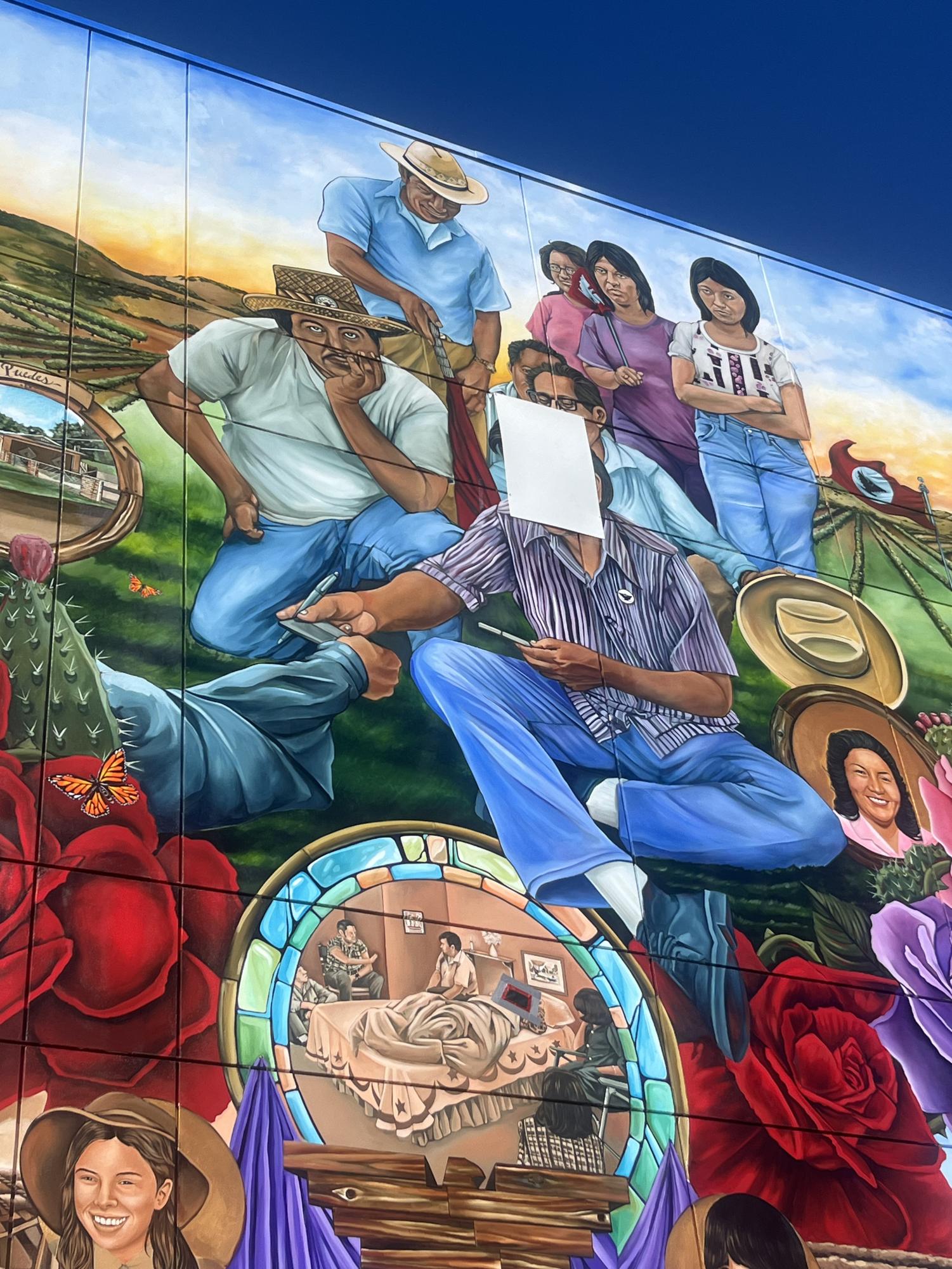
“I am nearly 96 years old, and for the last 60 years have kept a secret because I believed that exposing the truth would hurt the Farmworker movement I have spent my entire life fighting for,” says Dolores Huerta, co-founder of the National Farmworkers Association (NFWA) alongside the late activist, Cesar Chavez.
The NFWA was a civil rights organization established in California in 1962 to help agricultural workers earn higher wages and better working conditions, and was primarily composed of Mexican-American workers. Three years later, in 1965, civil rights activist and leader of the Agricultural Workers Organizing Committee (AWOC), Larry Itliong, joined together over 1,500 Filipino farmworkers and supporters to create the Delano Grape Strike, a grassroots movement with similar goals to the NFWA around freedom and rights for agricultural workers.
The following year, the NFWA and AWOC joined together to both amplify the movement and to combine further to create the United Farm Workers of America (UFW); leaders of the movement included Dolores Huerta, Larry Itliong, Philip Vera Cruz, and Cesar Chavez.
For the next five years, the UFW would participate in a nationwide boycott against California table grape growers; this meant strikes and protests, as well as a 1,000-mile march across California led primarily by Chavez. Ultimately, the boycotts gained over 15,000 participants. By creating the UFW, both Mexican-American and Filipino agricultural workers were able to work together to achieve their goals, including union rights and recognition for farmworkers, higher wages, and improved working conditions.
But as the movement grew, so did Chavez’s power and influence. On March 18, 2026, Huerta came out in a New York Times investigation with claims against Chavez, saying that he had raped her multiple times, along with similar claims from other women who had been a part of the movement.
In her statement, she claims that her first incident with Chavez had occurred when she was 36 years old, when Chavez drove her out to a secluded grape field in Delano and raped her in his vehicle.
“The first time I was manipulated and pressured into having sex with him, and I didn’t feel I could say no because he was someone that I admired, [he was] my boss and the leader of the movement I had already devoted years of my life to,” says Huerta in the statement, “The second time I was forced, against my will, and in an environment where I felt trapped.”
She then goes on to reveal how her experiences with Chavez resulted in two different pregnancies, but due to the circumstances of her situation, Huerta ultimately decided to give the children away, leaving them with no idea of their biological identities until a few weeks before her statement was posted.
Gregory Braithwaite, also known as “Greg,” is a World History teacher at Del Mar who says he was taken by shock after hearing the allegations.
“[I was] really depressed, because I really believe that the farm workers’ struggle is so relevant to our lives as workers and consumers,” says Braithwaite.
“I do believe that it is an incorrect narrative to overly focus on leaders,” says Braithwaite, “At the same time, it is nice to celebrate leaders and to look at their powerful words and speeches, and I don’t think that most people are going to know how to navigate [their feelings] for some time regarding Caesar Chavez. [But] that doesn’t mean that learning about the farm workers’ struggle is off the table at all since he’s a part of the story, but he is not the story.”
“Cesar Chavez is just a man,” says Esmerelda Lopez, another victim of Chavez who had grown up in the UFW.
In 1988, Chavez invited Lopez to join him on a speaking tour while she was working in the union. Once alone together in a trailer, Chavez then took advantage of 19-year-old Lopez.
“At one point, [Lopez] said, Mr. Chavez pointed to a street sign outside bearing his name and suggested that he could use his influence to get something named for her if she slept with him,” says the New York Times investigation.
Ten months after the incident, Chavez fired Lopez from the union.
But Lopez was not the only one in her family who had faced such interactions with Chavez. Lopez’s mother, Cynthia Bell, also recalls inappropriate remarks from Chavez; she claims that Chavez would imply that he saw Bell as a daughter, but would get ‘other feelings’ when they were alone.
“Unfortunately, he used some of his great leadership to abuse women and children — it’s really awful,” says Huerta.
Although some of the victims had less frequent interactions with Chavez, there have also been multiple victims who have come out and expressed that he spent multiple years manipulating and coercing them into doing inappropriate acts, starting when they were only children.
Ana Murguia had known Chavez ever since she was 8 years old; her family was close to Chavez as they were long-time UFW members. In the New York Times report, Murguia expressed how she would confide in Chavez and felt like he was the only adult in her life that she could go to for support, the only adult who ‘truly listened.’
“[Chavez] had an obsession with alternative healing therapies, [he would] put [Murguia] on his desk and demonstrate the ‘pressure points’ that could relieve stress and pain,” says the New York Times, “That eventually led to kissing, and then fondling. And then more,”
Murguia was 13-years-old when she had her first sexual encounter with him, and her abuse from Chavez ended when she turned 17: “I’m grown up. He told me to get out,” says Murguia.
Although Murguia’s abuse ended, Chavez’s predation didn’t.
Like Murguia, Debra Rojas grew up in the UFW with her parents as union members. When she was 12 years old, Chavez brought her into his office and touched her inappropriately for the first time.
Nearly a year after the incident, Rojas and Chavez began sending letters back and forth to one another, Rojas sending innocent notes as the usual 13-year-old would, but in return, she was met with romantic advances from Chavez
“He would tell her that they would move together someday to Mexico. He told her to stay away from other boys because he’d get jealous,” says the New York Times investigation, “He told her that the Flamingos song, ‘I Only Have Eyes for You,’ was their song, and that every time she heard it, she should ‘just remember that I love you.’”
“I didn’t know what the word grooming was,” says Rojas in the New York Times investigation, “It’s like you’re mesmerized.”
Following the letters, in 1975, Chavez had convinced Rojas’ family to allow their daughter to join him on his 1,000-mile march across California.
“My dad just wanted to be in his favor, because my parents loved him. We all loved him,” says Rojas.
Despite wanting Rojas to be on the journey with him, he decided to drive her back home at one point. They stopped at a motel on the way back, which is where Chavez raped her for the first time.
“She was a virgin, and remembers that it hurt, and she was bleeding. But she also remembers the gun Mr. Chavez had placed on the nightstand next to the bed,” says the New York Times investigation.
After the march had ended, Rojas recalls Chavez growing distant from her and telling her that he needed to return home to his wife.
As of right now, these five victims have been the only ones to speak out about their experiences with Chavez, but in total, there are over 60 potential victims and witnesses on the investigation list.
Huerta, Murguia, and Rojas all expressed the internal struggle they faced as a result of Chavez’s abuse; Murguia explains how she became suicidal by 15, began resorting to drug abuse, and still to this day struggles with anxious panic attacks and depression.
However, the victims faced an even greater struggle – gaining the courage to tell their stories to the public.
“My heart aches for everyone who suffered alone and in silence for years. There are no words strong enough to condemn those deplorable actions that he did,” says Huerta in her official statement, “Cesar’s actions do not reflect the values of our community and our movement.”
Santiago Camacho is a Junior from Colombia who says that the Farmworkers movement should be highlighted as it is a cause that is still relevant today: “I think we should care more about the Farmworkers movement [than Cesar Chavez himself],” says Camacho, “We should forget about that guy because he was a bad person […] I think they should care more about the Farmworkers movement because that’s more relatable to what is happening today.”
All of the victims expressed the fact that they were afraid to take away from the Farmworkers movement as a whole by speaking out about their experiences; minorities such as the Mexican-American community were already being patronized, and the victims didn’t want to diminish the cause even further by speaking out against the face of the movement, Chavez.
“Some of those closest to [the victims] begged them not to [speak out], arguing that it could not be a worse time […], where immigrants [are] facing widespread detention […] and the political rights of Hispanics [seem] too many to be under assault,” says the New York Times report.
“Cesar Chavez was a bad person, and I think [this situation] should be an example [of how we should show more respect towards women],” says Camacho.
These fears and allegations now raise a difficult question: how should the public honor the UFW’s achievements while also recognizing the allegations against one of its most famous leaders?
While Chavez was a huge part of bringing the movement to light, many individuals express that Chavez was not the only contributor to it.
“The leader [of a movement] is important, but the leader is not the sole movement,” Says Braithwaite, “Someone like Martin Luther King Jr is a great leader, and someone you know that everybody loves and admires […] Just as we study that movement, and we don’t just study a speech by Martin Luther King Jr, we study the people that worked alongside him, student organizations, the women’s groups […] We should already be doing the same when we’re studying the United Farm Workers — that’s how we should be learning history.”
“The Farmworker movement has always been bigger and far more important than any one individual,” says Huerta in her New York Times statement, “Cesar’s actions do not diminish the permanent improvements achieved for farmworkers with the help of thousands of people. We must continue to engage and support our community, which needs advocacy and activism now more than ever.”
UFW representatives reiterate Huerta’s message in their official response, saying the union’s dreams live beyond any single person and came to life with the power of an entire community.
“The allegations about abusive behavior by Cesar Chavez go against everything that we stand for,” says the UFW’s official statement regarding the allegations.
But even with the union condemning the allegations, the conflict has already reached the state. As of March 26, 2026, the California government has already decided to denounce “Cesar Chavez Day,” celebrated on March 31, with plans to rename it “Farmworkers Day.”
But while the state is considering changing the holiday’s name, debate is even more intense in places like San Jose, the exact place where Chavez started his leadership journey, as well as a place that has his name plated everywhere.
Amongst the allegations, the city of San Jose has been quick to cover or rename monuments that were once dedicated to Chavez, starting with the removal of his name at what once was “Plaza de Cesar Chavez.”
“As many in our community have noted, the movement itself, the workers, the marchers, and the women who stood on our front lines must continue to be celebrated,” says Cynthia Teniente-Matson, the president of San Jose State University, “Their contributions cannot be dimmed by the actions of one person.”
As cities and organizations respond, the bigger question is brought to light: what happens next?
“To my knowledge, we’ve not had any direct communication from the district to us,” says Braithwaite, “but in our department, we’ve been having these talks since the morning after we all unfortunately found out about the news, and it reiterates our commitment to provide historically accurate narratives in history.”
“I know in America, a lot of people have bad mental [health] problems,” says Camacho, “So I think they should [create more recognition] for mental health for people, so then we cannot have more people like Cesar Chavez.”
Students looking for support are welcome to visit Del Mar’s wellness center, which is open during break, lunch, as well as before and after school, for different support and resources. For students who are searching for immediate help, reach out to the National Sexual Assault Hotline at 1-800-656-4673 or the Suicide and Crisis Lifeline at 988.